Tags
#1Percenters, #ADMS, #AFDC, #BenjaminRadcliff, #CACFP, #CHIP, #ChristianValues, #CriticalThinking, #CSFP, #EBT, #Education, #EIC, #EntitlementPrograms, #EthicallyDeficient, #FoodStamps, #FranklinDRoosevelt, #Grants, #Healthcare, #leilaworldblog, #leilaworldblog1, #Medicaid, #Medicare, #MorallyBankrupt, #NewDeal, #RAND, #SNAP, #SocialPrograms, #SocialSecurity, #SSDI, #SSI, #StanleyDrunkenmiller, #SubsidyPrograms, #TANF, #UnemploymentInsurance, #WIC, Section8
“‘Spending like drunken sailors’: Billionaire Stanley Druckenmiller says US seniors need to ‘take a cut’ in Social Security — at a time when it isn’t enough for many Boomers. Do you agree?”
Social Security is not a freaking “Entitlement”. That statement alone is a gross insult to tay paying American Workers, that have worked their whole life. Then as they have aged, many of whom can not work like they did at 16-65 years old, rely soley on those funds that they contributed to the system, to take care of them. Albeit since Social Security can not keep up with inflation and general cost of living, many use it as supplemental income. This income literally means food, medicine, and housing for so many. For many they are still either at the poverty level or maybe slightly higher. That is reality.
It is downright shameful that certain wealthy individuals, and many certain politicians always look to cut programs for the elderly, children, and sick, before God forbid they cut Warfare, or “fat” self interest programs.
This kind of thinking breeds the thought our Country is only interested in what it can take from you. It doesn’t give a damn about taking care of you, or how you have contributed and given to the Country. Down right shameful.
Then these Politicians try and shove their “Religious” interpretted values at us Citizens, claiming in the name of “Christian Values”. Absolutely abhorrent. Just pure blasphemy, even as stated by the very books and philosophies they are very loosely applying, and preaching.
We really need some new blood in our goverment offices. We need so new innovators in our commerce sectors. We need a new way of critical thinking, of problem solving. People who aren’t so morally bankrupt, ethically deficient, appartently short sighted, self indulgent and greedy. We need people who can lead by both grit and example. We need people who can think of the majority, and not just the 1%. That is how we solve our various crisises. People who know how to prioritize, handle crisis management, and do it, delegate it, or dump it. Also, we need people who are frank. People who have the wherewithal to create actionable plans.
We don’t need the out dated, the showboat, the self serving, the fraud. And those that believe in kicking the downtrodden, or stealing from the less entitled, or thise with less, we don’t need you at all. You should remember you are only part of the 1% because you made yours off of the 99%’s backs, blood, sweat, and tears.
Meet Stanley F. Drunkenmiller
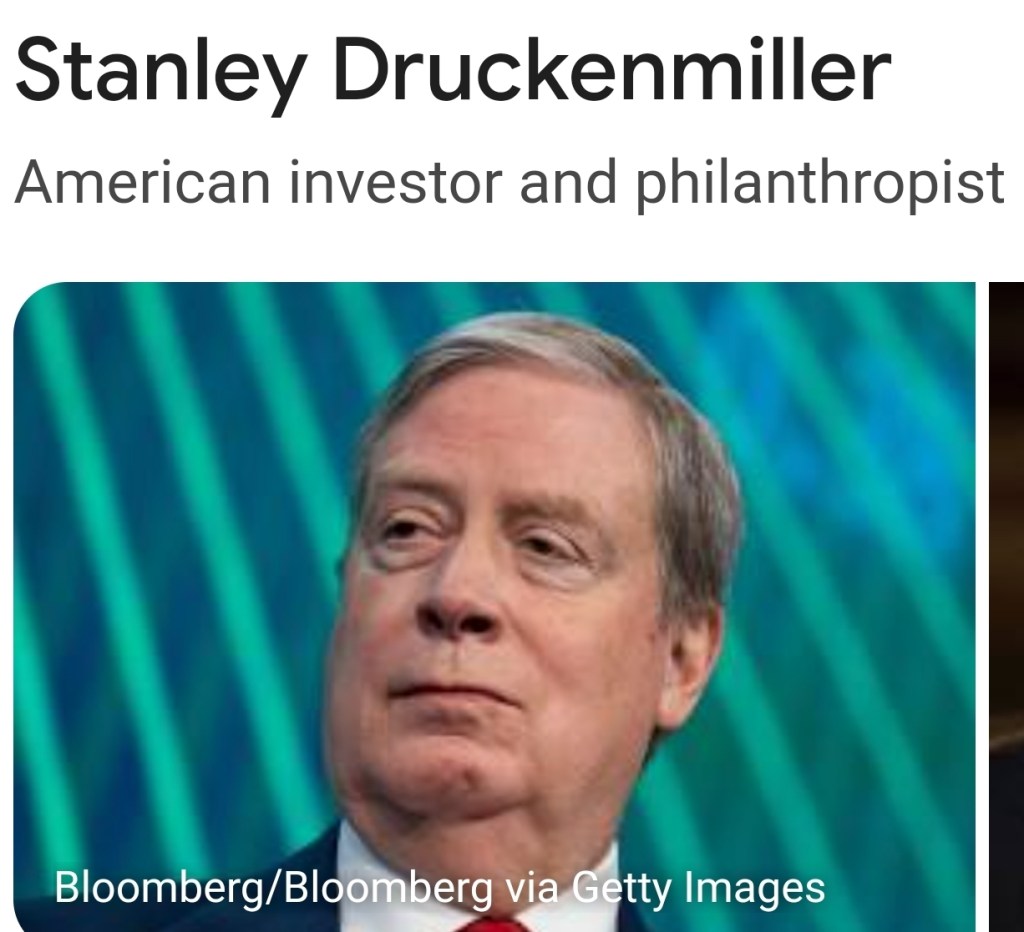
Stanley Freeman Druckenmiller (born June 14, 1953) is an American billionaire investor, philanthropist and former hedge fund manager. He is the former chairman and president of Duquesne Capital, which he founded in 1981. He closed the fund in August 2010. At the time of closing, Duquesne Capital had over $12 billion in assets. From 1988 to 2000, he managed money for George Soros as the lead portfolio manager for Quantum Fund. He is reported to have made $260 million in 2008.
Druckenmiller advocates reducing spending on entitlement programs such as Social Security. Druckenmiller was a major supporter of Republican Governor Chris Christie of New Jersey. In 2015, Druckenmiller donated $300,000 total to the presidential candidacies of Christie, Jeb Bush, and John Kasich.
In 2020, after the stock market crash and subsequent rally above pre-crash levels, Druckenmiller said he expects inflation in the US economy due to actions taken by the Federal Reserve. He made a similar warning in 2013 during an address at Bowdoin College in which he noted that, since 1994, he has been concerned that spending on government entitlement programs would lead to an economic crisis worse than the financial collapse of 2008.
So What Are Considered Entitlement Programs? What Are The Rules? Who Qualifies?
The United States spends approximately $2.3 trillion dollars on federal and state social programs include cash assistance, health insurance, food assistance, housing subsidies, energy and utilities subsidies, and education and childcare assistance. Similar benefits are sometimes provided by the private sector either through policy mandates or on a voluntary basis. Employer sponsored health insurance is an example of this.
American social programs vary in eligibility with some, such as public education, available to all while others, such as housing subsidies, are available only to a subsegment of the population. Programs are provided by various organizations on a federal, state, local, and private level. They help to provide basic needs such as food, shelter, education, and healthcare to residents of the U.S. through primary and secondary education, subsidies of higher education, unemployment and disability insurance, subsidies for eligible low-wage workers, subsidies for housing, Supplemental Nutrition Assistance Program benefits, pensions, and health insurance programs. Social Security, Medicare, Medicaid, and the Children’s Health Insurance Program are prominent social programs.
According to a 2020 study in the Quarterly Journal of Economics, U.S. government programs that focus on improving the health and educational outcomes of low-income children are the most effective, with benefits substantial enough that the government may even recoup its investment over time due to increased tax revenue from adults who were beneficiaries as children. Veto points in the U.S. structure of government make social programs in the United States resilient to fundamental change.
According to the Congressional Budget Office, social programs significantly raise the standard of living for low-income Americans, particularly the elderly. The poorest 20% of American households earn a before-tax average of only $7,600, less than half of the federal poverty line. Social programs increase such households’ before-tax income to $30,500. Social Security and Medicare are responsible for two thirds of that increase.
Political scientist Benjamin Radcliff has argued that more generous social programs produce a higher quality of life for all citizens, rich and poor alike, as such programs not only improve life for those directly receiving benefits (or living in fear of someday needing them, from the prospect of unemployment or illness) but also reduce the social pathologies (such as crime and anomie) that are the result of poverty and insecurity. By creating a society with less poverty and less insecurity, he argues, we move closer to creating a nation of shared prosperity that works to the advantage of all. Thus, his research suggests, life satisfaction (or “happiness”) is strongly related to the generosity of the social safety net (what economists often call decommodification), whether looking across the industrial democracies or across the American states.
Social programs have been implemented to promote a variety of societal goals, including alleviating the effects of poverty on those earning or receiving low income or encountering serious medical problems, and ensuring retired people have a basic standard of living.
Unlike in Europe, Christian democratic and social democratic theories have not played a major role in shaping welfare policy in the United States. Entitlement programs in the U.S. were virtually non-existent until the administration of Franklin Delano Roosevelt and the implementation of the New Deal programs in response to the Great Depression. Between 1932 and 1981, modern American liberalism dominated U.S. economic policy and the entitlements grew along with American middle class wealth.
Eligibility for welfare benefits depends on a variety of factors, including gross and net income, family size, pregnancy, homelessness, unemployment, and serious medical conditions like blindness, kidney failure or AIDS.
Drug Testing For Applicants
Main article: Drug testing welfare recipients
The United States adopted the Personal Responsibility and Work Opportunity Act in 1996, which gave individual states the authority to drug test welfare recipients. Drug testing in order for potential recipients to receive welfare has become an increasingly controversial topic. Richard Hudson, a Republican from North Carolina claims he pushes for drug screening as a matter of “moral obligation” and that testing should be enforced as a way for the United States government to discourage drug usage. Others claim that ordering the needy to drug test “stereotypes, stigmatizes, and criminalizes” them without need. States that currently require drug tests to be performed in order to receive public assistance include Arizona, Florida, Georgia, Missouri, Oklahoma, Tennessee, and Utah.
Demographics of TANF Recipients
Further Information: Temporary Assistance for Needy Families

Some have argued that welfare has come to be associated with poverty. Political scientist Martin Gilens argues that blacks have overwhelmingly dominated images of poverty over the last few decades and states that “white Americans with the most exaggerated misunderstandings of the racial composition of the poor are the most likely to oppose welfare”. This perception possibly perpetuates negative racial stereotypes and could increase Americans’ opposition and racialization of welfare policies.
In FY 2010, African-American families comprised 31.9% of TANF families, White families comprised 31.8%, and 30.0% were Hispanic. (Essentially meaning more White families were on TANF than everyone, since their numbers as whole are greater than all others).Since the implementation of TANF, the percentage of Hispanic families has increased, while the percentages of white and black families have decreased. In FY 1997, African-American families represented 37.3% of TANF recipient families, White families 34.5%, and Hispanic families 22.5%. As of 2013, the US population as a whole is composed of 63.7% whites, 16.3% Hispanic, 12.5% African-American, 4.8% Asian and 2.9% other races. TANF programs at a cost of about $20.0 billion (2013) have decreased in use as Earned Income Tax Credits, Medicaid grants, Supplemental Nutrition Assistance Program benefits, Supplemental Security Income (SSI), child nutrition programs, Children’s Health Insurance Program (CHIP), housing assistance, Feeding Programs (WIC & CSFP), along with about 70 more programs, have increased to over $700 billion more in 2013.
These Programs are what are considered Entitlement Programs specifically. It is important to understand them, in order to see, though the name suggest a negative connotation, the applications themselves are necessities for pure survival. They are designed for those in need. Unlike other First World Countries that have always had programs in place, America was almost last to implement Supplement Programs for the Elderly, Disabled, Impoverished, Ill, Unemployed (through no fault of their own), Education, Medical, or Children.
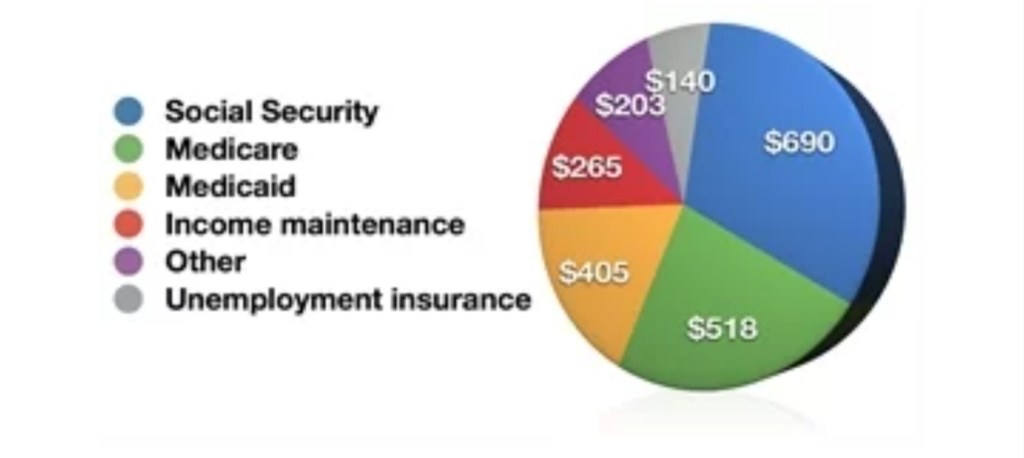
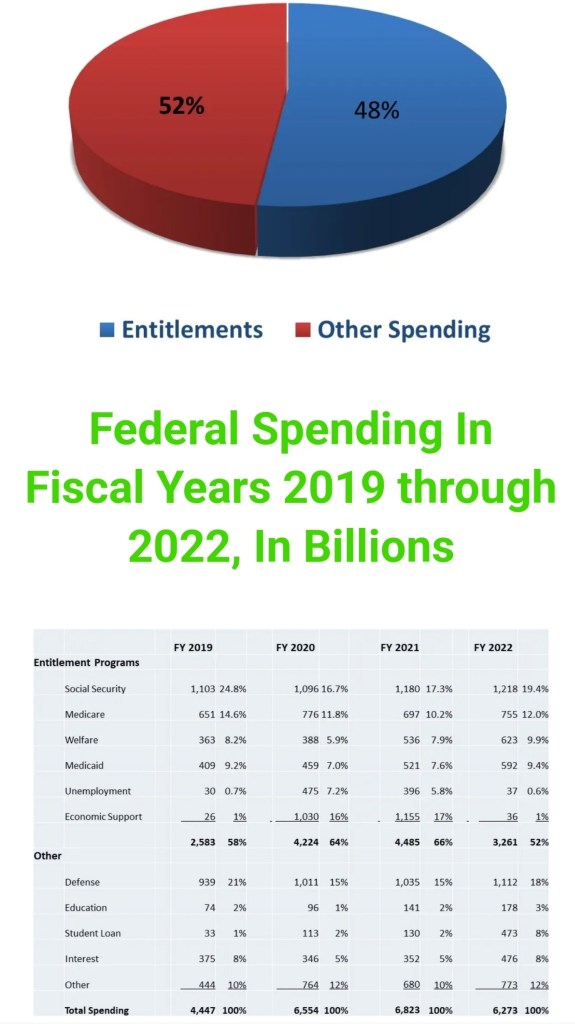
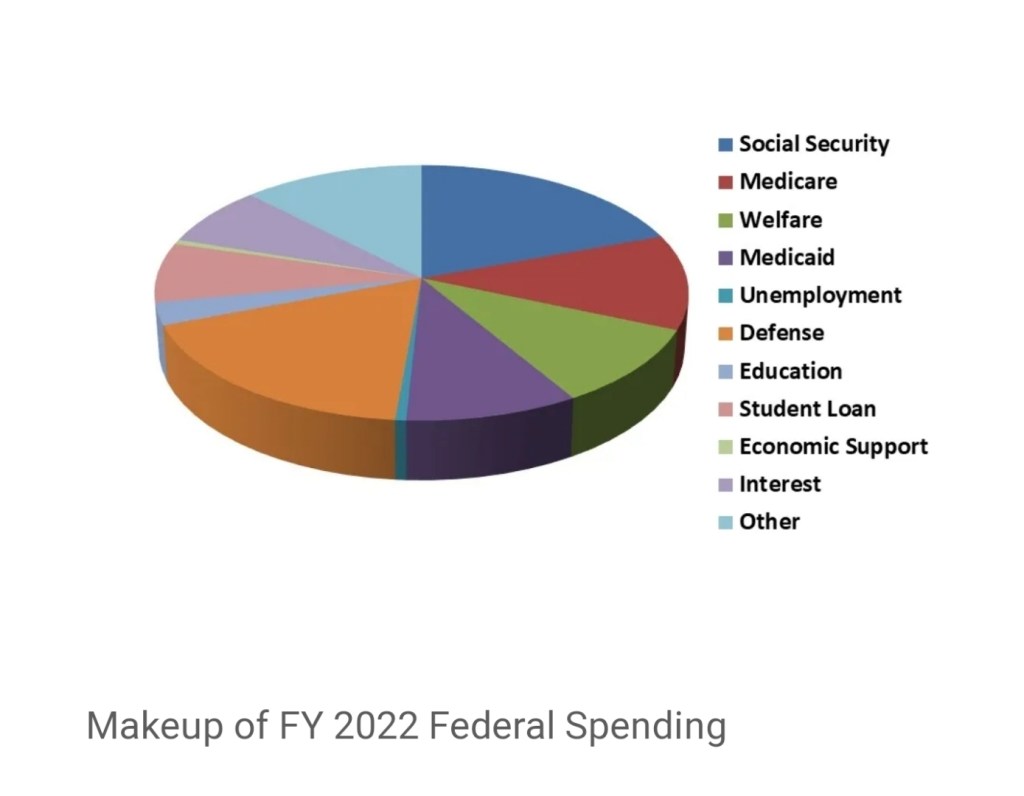
The table above shows total federal spending in billions of dollars for the past four fiscal years (“FY”). The federal government’s fiscal year ends on September 30 of each year. The chart includes entitlement spending and its share of total federal spending. Overall spending at the federal level increased from $4.4 trillion in FY 2019 to $6.8 trillion in FY 2021, an increase of over 50%. The cause of the increase was generally Coronavirus relief activities shown above as “economic support” and also included in increases to welfare of $173 billion or almost 50% over the two years. This increase was principally from expanding Child Care Programs, Housing Assistance Programs, and the Child Tax Credit. Unemployment costs increased by $366 billion also due to Coronavirus relief. Total federal spending totaled $6.3 trillion in 2022, a drop of $550 billion due to reductions in economic support related to Coronavirus relief efforts, offset by an increase in student loan expense.
Deficit Spending
The increase of over $4.5 trillion in spending for a two-year period of 2020 and 2021 compared to 2019 is an unprecedented increase in federal outlays for an emergency other than war funding. The deficit for the years 2020 and 2021 were $3.1 and $2.8 trillion, so the entire Coronavirus relief effort was financed by debt. The deficit in FY 2022 totalled $1.4 trillion.
Social Security
Main article: Social Security (United States)
The Social Security program mainly refers to the Old Age, Survivors, and Disability Insurance (OASDI) program, and possibly to the unemployment insurance program. Retirement Insurance Benefits (RIB), also known as Old-age Insurance Benefits, are a form of social insurance payments made by the U.S. Social Security Administration paid based upon the attainment of old age (67 or older).
Social Security Disability Insurance (SSD or SSDI) is a federal insurance program that provides income supplements to people who are restricted in their ability to be employed because of a notable disability.
Unemployment Insurance, also known as unemployment compensation, provides for money (from the United States and from the individual states) collected from employers, to workers who have become unemployed through no fault of their own. The unemployment benefits are run by each state with different state-defined criteria for duration, percent of income paid, etc. Nearly all systems require the recipient to document their search for employment in order to continue receiving benefits. Extensions of time for receiving benefits are sometimes offered for extensive work unemployment. These extra benefits usually take the form of loans from the federal government that each state has to repay.
General Welfare
Main articles: Supplemental Security
Income and Temporary Assistance for Needy Families
The Supplemental Security Income (SSI) program provides stipends to low-income people who are either aged (65 or older), blind, or disabled.
The Temporary Assistance for Needy Families (TANF) provides cash assistance to indigent American families with dependent children.
Healthcare Spending
Main articles: Health care in the United States, Medicare (United States), and Medicaid
Health Care in the United States is provided by many separate legal entities. Health care facilities are largely owned and operated by the private sector. Health insurance in the United States is now primarily provided by the government in the public sector, with 60–65% of healthcare provision and spending coming from programs such as Medicare, Medicaid, TRICARE, the Children’s Health Insurance Program, and the Veterans Health Administration. Having some form of comprehensive health insurance is statutorily compulsory for most people lawfully residing within the US.
Medicare is a social insurance program administered by the United States government, providing health insurance coverage to people who are aged 65 and over; to those who are under 65 and are permanently physically disabled or who have a congenital physical disability; or to those who meet other special criteria like the End Stage Renal Disease Program (ESRD). Medicare in the United States somewhat resembles a single-payer health care system but is not.[why?] Before Medicare, only 51% of people aged 65 and older had health care coverage, and nearly 30% lived below the federal poverty level.
Medicaid is a health program for certain people and families with low incomes and resources. It is a means-tested program that is jointly funded by the state and federal governments, and is managed by the states. People served by Medicaid are U.S. citizens or legal permanent residents, including low-income adults, their children, and people with certain disabilities. Medicaid is the largest source of funding for medical and health-related services for people with limited income in the United States.
The Children’s Health Insurance Program (CHIP) is a program administered by the United States Department of Health and Human Services that provides matching funds to states for health insurance to families with children. The program was designed to cover uninsured children in families with incomes that are modest but too high to qualify for Medicaid.
The Alcohol, Drug Abuse, and Mental Health Services Block Grant (or ADMS Block Grant) is a federal assistance block grant given by the United States Department of Health and Human Services. Drug addiction, particularly the use of heroin, is an increasing cause of physical and mental disabilities. Treatment with methadone clinics can be supported by Medicaid and state healthcare programs.
The Trump administration has decided to cut $9 million in Affordable Care Act subsidies by 2018. This action was taken by use of Executive Order 13813, on October 12, 2017. The initial goal had been for Republicans in Congress to use their majority to “repeal and replace” the Affordable Care Act, but they proved unable to do so; therefore, the Trump administration itself took measures to weaken the program. The healthcare changes are expected to be noticeable by the year 2019.
Education spending
Main article: Education in the United States
University of California, Berkeley is one of the oldest public universities in the U.S.
Per capita spending on tertiary education is among the highest in the world[citation needed]. Public education is managed by individual states, municipalities and regional school districts. As in all developed countries, primary and secondary education is free, universal and mandatory. Parents do have the option of home-schooling their children, though some states, such as California (until a 2008 legal ruling overturned this requirement), require parents to obtain teaching credentials before doing so. Experimental programs give lower-income parents the option of using government issued vouchers to send their kids to private rather than public schools in some states/regions.
As of 2007, more than 80% of all primary and secondary students were enrolled in public schools, including 75% of those from households with incomes in the top 5%. Public schools commonly offer after-school programs and the government subsidizes private after school programs, such as the Boys & Girls Club. While pre-school education is subsidized as well, through programs such as Head Start, many Americans still find themselves unable to take advantage of them. Some education critics have therefore proposed creating a comprehensive transfer system to make pre-school education universal, pointing out that the financial returns alone would compensate for the cost.
Tertiary education is not free, but is subsidized by individual states and the federal government. Some of the costs at public institutions is carried by the state.
The government also provides grants, scholarships and subsidized loans to most students. Those who do not qualify for any type of aid, can obtain a government guaranteed loan and tuition can often be deducted from the federal income tax. Despite subsidized attendance cost at public institutions and tax deductions, however, tuition costs have risen at three times the rate of median household income since 1982. In fear that many future Americans might be excluded from tertiary education, progressive Democrats have proposed increasing financial aid and subsidizing an increased share of attendance costs. Some Democratic politicians and political groups have also proposed to make public tertiary education free of charge, i.e. subsidizing 100% of attendance cost.
Food Assistance
Main articles: Supplemental Nutrition Assistance Program and Special Supplemental Nutrition Program for Women, Infants and Children
In the U.S., financial assistance for food purchasing for low- and no-income people is provided through the Supplemental Nutrition Assistance Program (SNAP), formerly known as the Food Stamp Program. This federal aid program is administered by the Food and Nutrition Service of the U.S. Department of Agriculture, but benefits are distributed by the individual U.S. states. It is historically and commonly known as the Food Stamp Program, though all legal references to “stamp” and “coupon” have been replaced by “EBT” and “card,” referring to the refillable, plastic Electronic Benefit Transfer (EBT) cards that replaced the paper “food stamp” coupons. To be eligible for SNAP benefits, the recipients must have incomes below 130 percent of the poverty line, and also own few assets. Since the economic downturn began in 2008, the use of food stamps has increased.
The Special Supplemental Nutrition Program for Women, Infants and Children (WIC) is a child nutrition program for healthcare and nutrition of low-income pregnant women, breastfeeding women, and infants and children under the age of five. The eligibility requirement is a family income below 185% of the U.S. Poverty Income Guidelines, but if a person participates in other benefit programs, or has family members who participate in SNAP, Medicaid, or Temporary Assistance for Needy Families, they automatically meet the eligibility requirements.
The Child and Adult Care Food Program (CACFP) is a type of United States federal assistance provided by the U.S. Department of Agriculture (USDA) to states in order to provide a daily subsidized food service for an estimated 3.2 million children and 112,000 elderly or mentally or physically impaired adults[46] in non-residential, day-care settings.
A RAND study has concluded that almost 70% of the veterans who are older than 70 are food-insecure but are not using government assistance programs.
Public housing
Main articles: Public housing in the United States and Section 8 (housing)
The Housing and Community Development Act of 1974 created Section 8 housing, the payment of rent assistance to private landlords on behalf of low-income households.
Though these numbers are slightly dated, with the most current numbers being far worse, it is important that you understand what these programs are, and who they impact. I believe many people are quick to say lets cut this “Entitlement Program”, or that “Entitlement Program”, because they simply do not understand what the program is, how it is applied, to whom it applies to. Most people don’t think any of these programs apply to them, until they are already using them. Sad but true. Also, the sheer numbers of how many Americans this applies to.
It is not that we should cut these programs, as much as maybe that 1% of wealthy Americans, and American Companies pay their full share of taxes, without the ability to have so many loophole exemptions. Maybe, certain organizations shouldn’t qualify for full tax exemptions period. Balance the burden of the economy. What is that saying “you can’t get blood from a turnip”, something like that.
It is easy to say cut these programs when you, or your company is 1% wealthy, and not only do you use every exemption possible, but every loophole, or transfer your wealth to other countries in order to not pay taxes. This doesn’t even including holding your hand out when any kind of relief effort for emergencies is given. Or, the seemingly endless subsidies you receive from the government. Meanwhile, the 99% who is getting by at best, to barely making it, is paying 15-33% some even more in taxes.
It always amazes me how even as majority of these 1%ers get wealthier and wealthier each year, little is given to everyone who is not in executive management or higher. Then, when forced to, the 1%ers complain how it affects their bottom line too much. Yet, in the same breath, their executive branch, upper management, and shareholders, are riding into the sunset with quarterly to annual bonuses. So much so, the grossly indulgent bonuses are being received even as jobs are getting cut.
Tell me please how that is right. I have zero against anyone being wealthy. I do take offense when the extremely weathy party or parties, blame the poor, or hard working, or infirmed, or less off, for them not being wealthier. Oh, and insinuate that those on these programs want to be on programs. That is just crazy talk. No one wants to have food, housing, or medical worry. Will they have food today, a roof over their head, medicine for their heart, blood pressure? Will their child have school? Will they be able to get to their doctor’s appointment? No one wakes up wanting the suffocating stress of will they survive today, let alone their families.
That is what blows my mind in this mentality about “Entitlement Programs”. The should rename it to “Humane Programs”, or call it what it is, “Survival Programs”.
What are your thoughts?
This blog piece of mine was inspired by an article I read today:
Read “‘Spending like drunken sailors’: Billionaire Stanley Druckenmiller says US seniors need to ‘take a cut’ in Social Security — at a time when it isn’t enough for many boomers. Do you agree?” on SmartNews:
https://l.smartnews.com/p-QBb2L/XGy3FZ
The Original Article:
With the U.S. national debt totalling over $33 trillion and the White House calling for billions of dollars more in spending packages, billionaire investor Stanley Druckenmiller is calling for action to offset to the costs.
“We are spending like drunken sailors,” he said on CNBC’s Squawk Box.
Druckenmiller went on to explain that the federal government was spending 20% of the country’s GDP prior to the COVID-19 pandemic — but this proportion has since climbed to 25%.
“My father told me ‘if you’re in a hole, stop digging Stan.’”
Druckenmiller proposes the government slash funding to a source of income for millions of U.S. seniors — Social Security. Here’s why and by how much.
America has a spending problem.
The U.S. has been running a deficit for years — with the federal government spending $1.7 trillion more than it collected in the 2023 fiscal year alone.
And under a deficit, in order to pay for government programs, such as Social Security and emergency relief, the government borrows money, in part, by selling Treasury bonds, bills and other securities. This, of course, adds to the national debt.
In October, President Biden requested nearly $106 billion in funding from Congress, with $61.4 billion going toward Ukraine and $14.3 billion in military aid for Israel, including air and missile defense support.
“I was actually happy to see the announcement — the support for Ukraine and Israel,” Druckenmiller said during the CNBC interview. “I was waiting to see what the offset was going to be.”
The former hedge fund manager goes on to say that he was surprised to see the White House announce another $56 billion in emergency spending that includes money for child care, disaster relief and aid for lower-income Americans.
“Child care is not emergency spending,” he says.
But some experts would disagree.
The country is currently on the edge of a “child care cliff”, after the expiration of the Child Care Stabilization Program, which was introduced in 2021.
Think tank The Century Foundation reported that millions of children are at risk of losing their daycare spots and families could lose billions of dollars each year due to reduced hours or leaving the workforce entirely.
Druckenmiller wants cuts to “entitlements”
When asked whether he agreed with the House Republicans’ proposal to fund Israel with $14.3 billion by cutting funding to the IRS, Druckenmiller sidestepped the question.
“I want to go after entitlements. It’s where the money is,” he said.
Druckenmiller believes future seniors will have to face a cut to their Social Security benefits “no matter what.”
“This generation has got to take a cut,” he says. “Right now, current seniors, you’re going to get 100 cents on the dollar. Future seniors looking at five or 10 cents on the dollar, is it not unreasonable for us to go to 85 or 90 cents on the dollar?”
But with inflation prices keeping prices high, Social Security benefits are already insufficient, especially for low-income seniors already hurt by the expiration of extra food stamp aid in March.
In fact, older adults are now the fastest-growing segment of America’s homeless population, according to the Wall Street Journal.
Overall, the benefits make up about a third of a middle-income earner’s average wages, even though Mary Johnson, a Social Security and Medicare policy analyst at The Senior Citizens League, previously told Moneywise over half of older households have no savings to fall back on and rely mainly on their Social Security income in retirement.
To make matters worse, the reserves of the program’s main fund are projected to run out by 2033, meaning retirees would only receive 77% of their full benefits.
Now that you know, what is your opinion?
 Leila World Blog