
“No, it’s not a painting and it wasn’t photoshopped either. These are polar stratospheric clouds over Iceland.”

Polar stratospheric ice clouds (naked clouds) form at temperatures below the ice sublimation point, usually around −85 °C, a temperature lower than the average temperature of the lower stratosphere.
Polar stratospheric clouds (PSCs) are colorful, high-altitude clouds that form in the lower stratosphere during winter and early spring near the poles. They are known for their role in ozone depletion, particularly in the Antarctic.

Formation:
PSCs require temperatures around -78°C (-108°F) and extremely dry conditions. They form poleward of 60°S latitude at altitudes of 15–25 km.
Types:
There are two types of PSCs, classified by particle size and formation temperature:
Type I:
Contain nitric and sulfuric acid, and water, forming 5–8°C above the frost point.
Type II:
Also known as nacreous or mother-of-pearl clouds, they contain only water ice and form below the ice frost point.
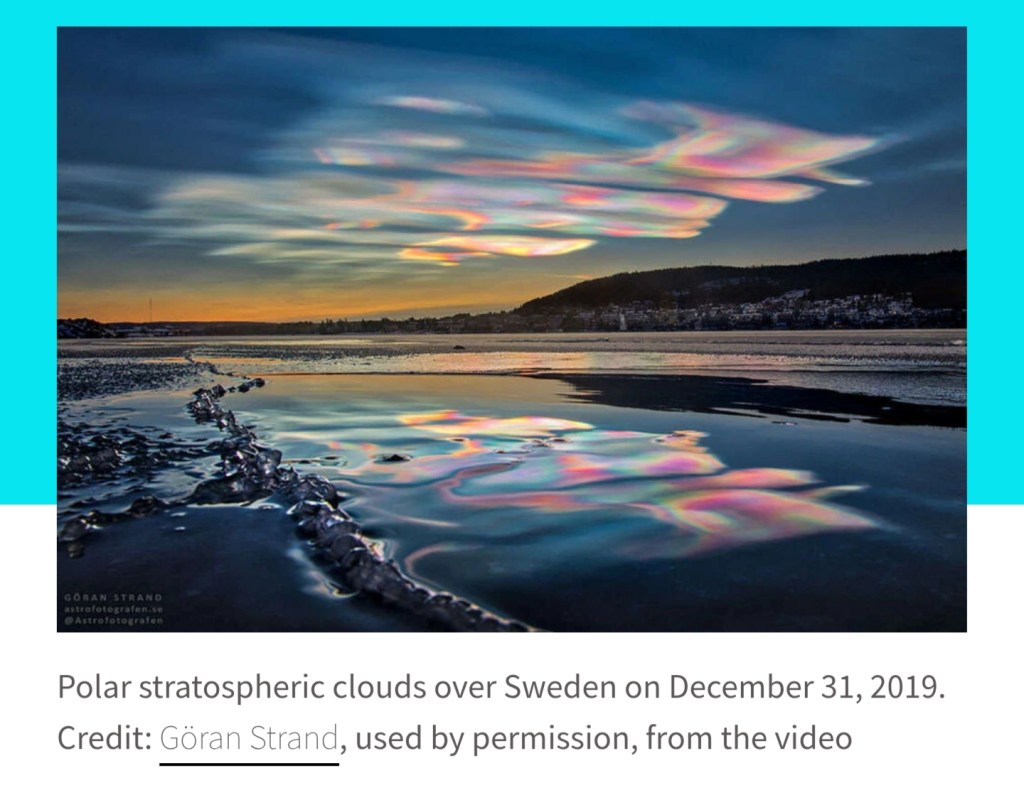
Polar stratospheric clouds (PSCs) are harmful because they play a crucial role in the destruction of the ozone layer, particularly in the polar regions. These clouds provide surfaces that convert less reactive forms of human-made chlorine into highly reactive forms that can destroy ozone molecules. When sunlight returns after the polar winter, these reactive chlorine compounds are broken down, releasing free radicals that deplete ozone through a chain reaction.
Here’s a more detailed explanation:
Ozone Layer Protection:
The ozone layer in the stratosphere acts as a shield, protecting Earth from harmful ultraviolet (UV) radiation from the sun.
Polar Stratospheric Clouds (PSCs):
These clouds form in the extremely cold temperatures of the winter stratosphere over the poles.
Chemical Reactions:
PSCs provide surfaces where chemical reactions can occur, converting relatively harmless chlorine compounds (like chlorine nitrate) into reactive forms (like chlorine monoxide).
Ozone Depletion:
When sunlight returns after the polar winter, it triggers the breakdown of these reactive chlorine compounds, releasing chlorine free radicals that rapidly destroy ozone molecules.
Ozone Hole:
This process is particularly significant over Antarctica, leading to the formation of the ozone hole during the Antarctic spring.
Impact:
Ozone depletion increases the amount of harmful UV radiation reaching the Earth’s surface, posing risks to human health (e.g., skin cancer) and ecosystems.
Climate Change:
Climate change can affect PSC formation. Cooling in the lower stratosphere can lead to increased PSC formation, potentially exacerbating ozone depletion.
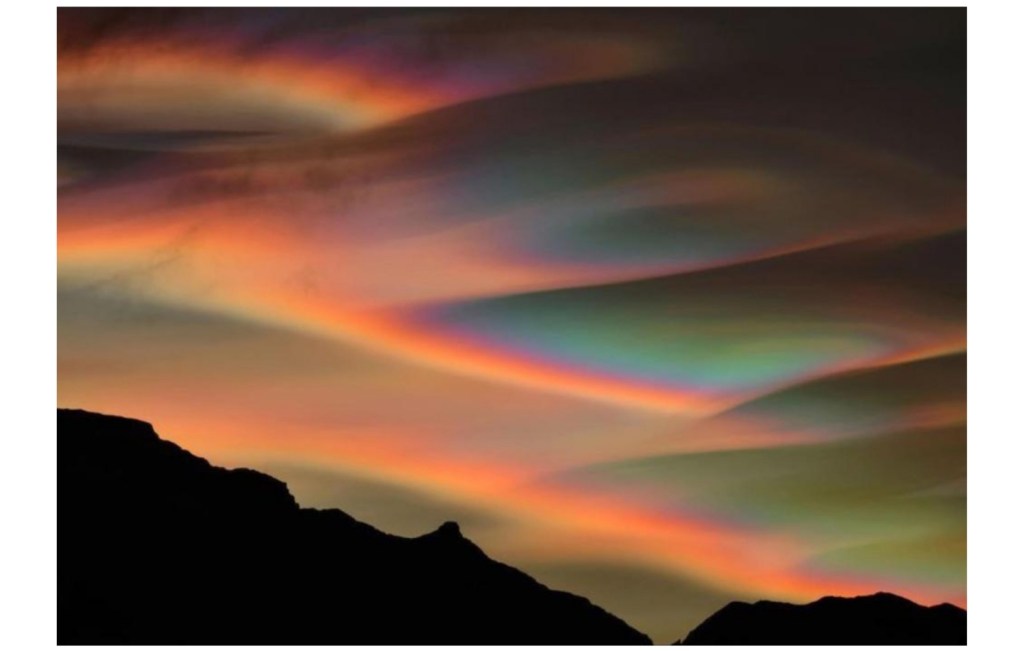
They only form at high latitudes, in the Arctic or Antarctic (hence the first adjective in their name), and occur very high up in the atmosphere, around 15,000 meters or higher, in the stratosphere (hence the second adjective). They’re difficult to see at night or during the day, but they’re so high up that at twilight they’re still lit by the Sun long after it sets for someone on the ground, making them more easily visible.1
There are different kinds, though they all consist of tiny water ice particles; some have small amounts of chemicals in them like nitric acid. Because some can shine with a silvery, mother-of-pearl glow to them they’re also called nacreous clouds.

I am also something of a nephophile. Coming from the Greek word nephos for clouds.
I have been watching wind for as long as I can remember. Listening to the sound of the trees sing as the wind passes thru. Watching the flowers dance with the bees and ladybugs enjoying the nectar and pollen that sustain us. Watching the fields of grass sway as the smell is so beautiful and vibrant. All the time admiring in awe of their partners, the clouds.
Clouds. Let’s talk about the clouds. Many times seeing images and imagery, as if a sign from God and the Heavens themselves. Always in gratitude, and awe of their magnificence. Clouds have always seemed like a direct telephone line from the Heavens.
I have many friends who have traveled to Iceland. They always talk about the stars. For me, I wouldn’t be able to stop talking about the clouds, and then of course those stars and the Auroras.

1. Auroras (Northern and Southern Lights):
- Definition:Auroras are natural light displays in the sky, predominantly seen in high-latitude regions (around the Arctic and Antarctic).
- Cause:They are caused by collisions between charged particles released from the sun (solar wind) and gaseous particles in Earth’s atmosphere.
- Colors:The colors of the aurora (green, red, blue, purple) depend on the type of gas particles and the altitude at which the collisions occur.
- Other planets:Auroras are not unique to Earth; they are also observed on other planets with atmospheres and magnetic fields, such as Jupiter and Saturn.
- Where to see them:The Aurora Borealis is most visible in regions like Iceland, northern parts of Scandinavia, Canada, Alaska, and Russia.

With so much beauty in Iceland, I might be able to forget the always cold and having to dress like a polar bear, and forget I need cow in my regular diet (I actually do in particular). Because it really is amazingly beautiful and terrifying at the same time.
 Leila World Blog