
Tags
#fknewtarriffs, #globaleconomy, #tarriffs, #thetruthabouttarriffs, #trickledowntheory, #trumpeconomics, #trumptarriffs, #USconsumerism, #USconsummers, #whopaysthetartiffs, Trump

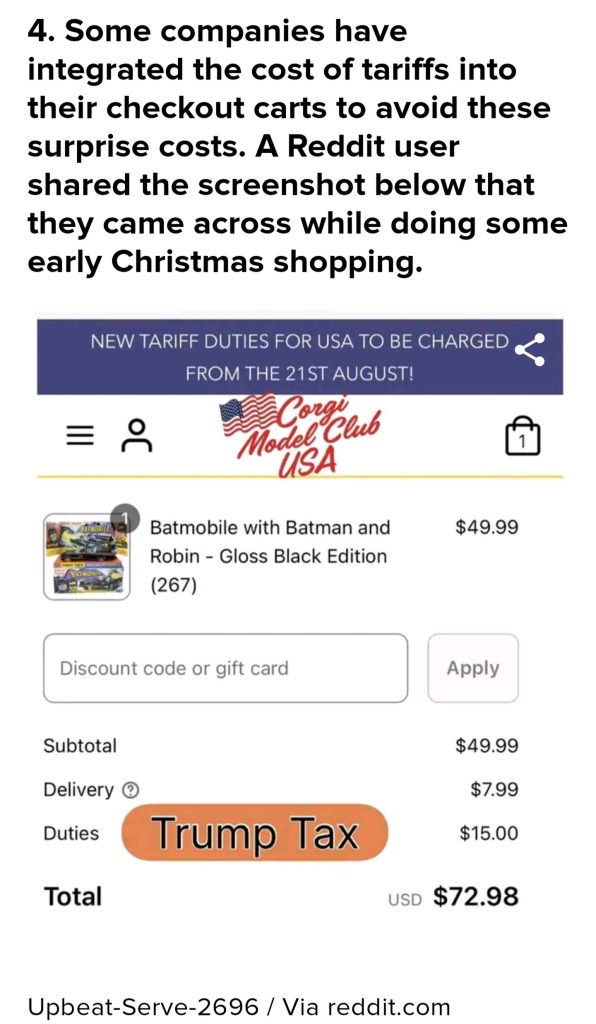
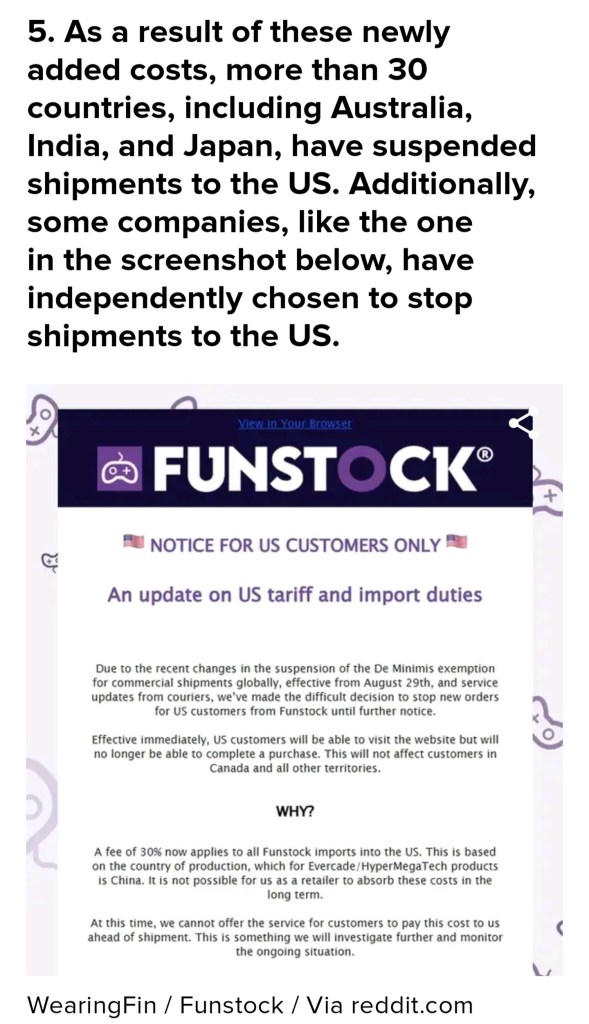
As you may know, I am often inspired by current events, or my daily findings, for inspiration as to what I write about. I came across this article today:
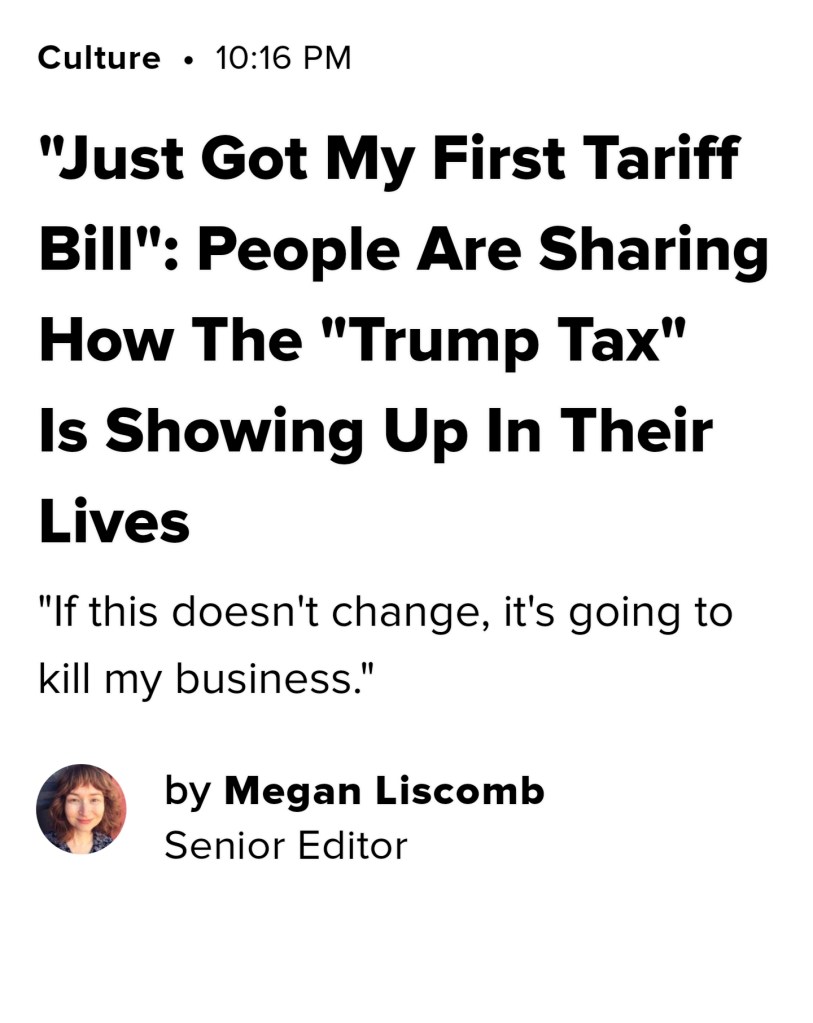
“Just Got My First Tariff Bill”: People Are Sharing How The “Trump Tax” Is Showing Up In Their Lives
Published by website BuzzFeed for Culture
Written by Megan Liscomb, Senior Editor
September 8th, 2025
This article highlights what many of us have been trying to open people’s eyes to. The dangers of excessive and self interests motivated tarriffs. Namely, Trump and his associates whom he does business with, needs something from, or is family with, how they benefit, vs. How tarriffs actually affect the general U.S. Consumers.
They say always follow the money.
Overall Family Income from the Trump Presidency: An analysis from The New Yorker estimated the Trump family businesses netted a total of $3.4 billion from his time in politics, through various ventures including crypto, real estate, and licensing agreements.
He is literally making the wealthiest .01% wealthier, the Rich are becoming richer, decimating the Poor to Poverty, knocking down the Lower Middle Class to Poor, the Middle Class to Lower Middle Class, all the way until you get to Upper Middle Class. Upper Middle Class is where the divide comes.
Mind you these are general examples. How most people assumes everyone else lives. Not everyone in these categories lives the ways presented below.
The Upper Middle Class is fighting to stay there, or fighting to gain ground to Upper Upper Middle Class. You know, not quite Rich, but has some investments. May own a home too. Vacations. Doesn’t necessarily fret over a surprise car repair, or medical bill. Still goes out to dinner, or events regularly kinda thing.
You have the Rich, who do mostly whatever they want. They Summer and Winter for holiday breaks. They throw lavish events. Belong to various Society Groups, but some of them still work. Some have to work to support their lifestyle.
Then you have the Wealthy. They don’t have to work, have created Generational Wealth typically.
Then you have the 3%ers, 1%er, and the .01ers.
The .01%ers are usually actively part of Multi-Generational wealth.
Now this doesn’t include the ‘New Money’ people. Those involved in starting companies, Crypto Currency, Technology, or various Investing. Those people are in a league to themselves in each category. Some ‘New Money’ comes from descendants of Multi-Generational or Generational wealth.
All of this plays a big part in how we have tarriffs and who is being tarriffed and why. How it affects EVERYONE’S bottom line.
This is the beginning of our new reality. EVERYONE is going to notice come the Holidays. Hell, even the cost of candy is up. #FKNEWTARRIFFS
Yeah, EVERYONE is going to feel it. We are a GLOBAL ECONOMY!!! Did you know there is a reason why we import Candian trees for wood? Their story is a tale of the U.S. being a GLOBAL BUSINESS. We simply cannot, nor should we want to, produce everything here.
…
The United States imports Canadian trees for wood due to Canada’s large supply of specific, high-quality softwood lumber suitable for construction, lower harvesting costs from government-owned lands, and established supply chains. While U.S. forests are abundant, limited logging on federal lands and the higher costs of harvesting from private U.S. lands contribute to the demand for Canadian lumber.
Reasons for Importing Canadian Wood
Abundant Supply of Softwood:
Canada has vast forests with an enormous capacity to produce and export softwood lumber, meeting a significant portion of U.S. demand.
High Quality Wood:
Canadian softwood, particularly SPF (Spruce-Pine-Fir), is preferred for its strength and durability, which comes from its slower growth in a harsh climate, resulting in dense, strong wood with narrow growth rings.
Lower Harvesting Costs:
Most of Canada’s forest land is government-owned, and timber harvesting leases are often subsidized with low stumpage fees (royalties), which are lower than the fees charged by private landowners in the U.S..
Convenient Proximity:
As the closest neighbor, Canada offers efficient supply chains, making it easier and more cost-effective to transport lumber to American builders compared to sources from other countries.
Domestic Forest Limitations:
The U.S. has limited old-growth forests on federal lands available for timber harvesting, especially after restrictions were put in place for species like the Northern Spotted Owl. Harvesting on the limited privately-owned U.S. timberland is often more expensive.
Impact of Trade Policies
Tariffs and Costs:
Tariffs placed on Canadian lumber by the U.S. government have led to higher prices for lumber, increasing the cost of home construction in the U.S..
Economic Consequences:
These tariffs can hurt American consumers and the construction industry by raising prices, potentially leading to increased costs for housing.
Lumber is one example. Sugar is another. Rubber is another. Plastic is another.
We import rubber because there is insufficient domestic production capacity due to climate limitations, and demand consistently exceeds supply, particularly for natural rubber. Natural rubber from the Hevea brasiliensis tree is essential for many products like tires and medical supplies but requires a hot, humid climate found mostly in Southeast Asia. Additionally, the global supply chain is vulnerable to disruptions, making imports a strategic necessity to meet the demands of industries from transportation to defense, according to MITRE Corporation.
Limited Domestic Production
Climate Requirements:
The Hevea brasiliensis rubber tree, which produces most commercial natural rubber, requires a specific hot and humid climate that is not present in the United States.
Lack of Domestic Supply:
As a result, the U.S. and other countries with similar climates must rely on importing natural rubber from regions like Southeast Asia where these trees can thrive.
High Demand Exceeds Supply
Essential Uses:
Natural rubber is indispensable for many critical applications, including aircraft and truck tires, high-performance seals, conveyor belts, and medical devices.
Supply Chain Fragility:
The supply of natural rubber is sensitive to disruptions from diseases affecting trees, severe weather events, geopolitical issues, and political disputes.
Strategic Importance
National Security:
Access to natural rubber is vital for military and civilian applications, and its disruption could have significant national security implications, notes the U.S. Tire Manufacturers Association.
Economic Stability:
A sudden cut-off in the supply of natural rubber could lead to severe economic consequences due to its broad use in manufacturing, transportation, and other key industries
You and everyone will really notice it in the grocery store when you go to buy beef, or fruits, or veggies. Even the cost of rice, to canned goods. Everyone was so focused on milk and eggs, many zoned out on other foods. Either the cost has and is going up, or stores simply aren’t carrying a certain product or product line anymore.
Hell, I went to Taco Cabana, on my way to Houston last week. Taco Cabana has a total of approximately 148 locations, with 142 corporate locations and 6 franchisee-owned locations in New Mexico. The company is under new ownership and is currently exploring plans to expand its brand beyond its primary market in Texas and New Mexico through a franchising program, with the goal of establishing a national presence.
They have cut their menu down from regular offerings, to just select offerings. Even their condiments and ‘extras’ Salsa Bar went from 12 offerings, to just 3. All the way they don’t even offer add-ons to dishes versions. Instead you must buy each add on. With a price point of $1+ for a small 1/4 oz. of cheese or sour cream or avocado.
Have you notice the cost of ketchup or mayo has drastically increased, yet the size is smaller? The Holidays and end of year is when it will finally start sinking in for people.
The cost of cars? The cost of buy or renting a home? The cost of movie or entertainment concessions. The cost of bandages, hydrogen peroxide, or rubbing alcohol? Toothpaste? The cost of toys? The cost of general services. All subject to the repercussions of the ‘New Trump Tarriffs’.
If you think companies and shareholders can, or will, absorb all, or any of the costs of their already dwindling margins, think again. They simply can not and won’t be able to sustain the business and make profit, or return on their investments.
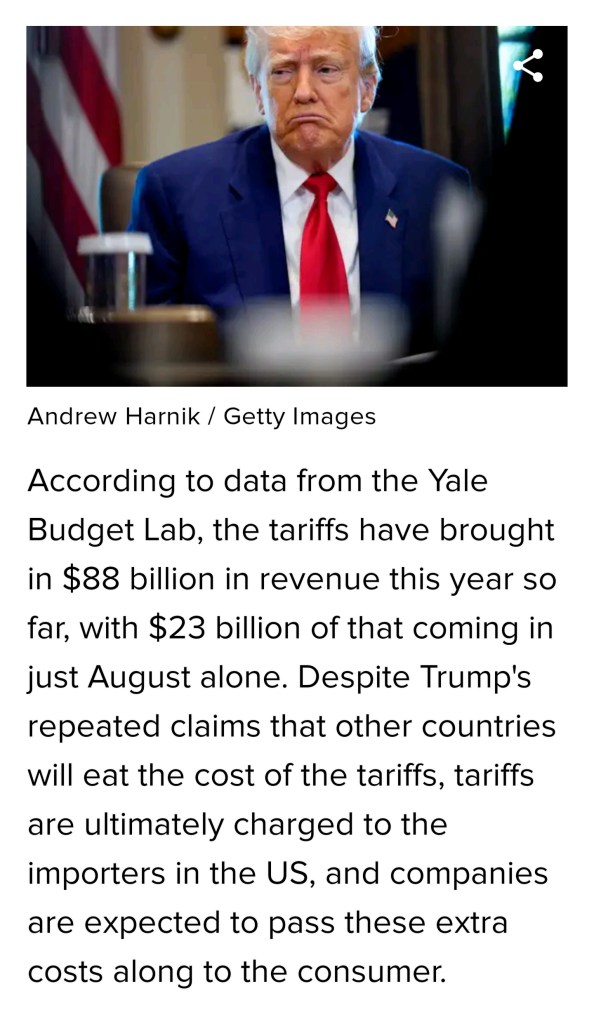
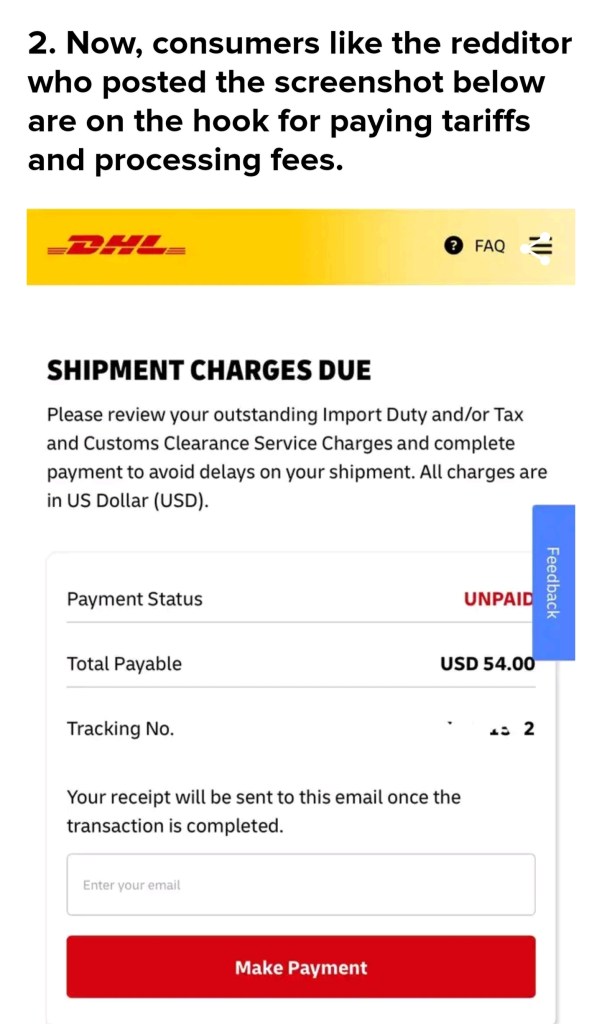
Those rising costs will be passed down to the consumer. The end consumer aka ‘us’, ‘We the People’. Who will in turn pay the stiffer higher cost for various items to the supplier, the manufacturer, the importer, and transportation, the exporter too. Plus, the real kicker is we will pay State and Federal Taxes on top of the item we purchased, at the higher cost. The higher the cost, the higher the taxes.
So, yes the government is collecting tarriff money. WE, the consumer, no matter what your financial bracket, are paying the tarriff monies. However, it doesn’t affect us all the same.
This is why excessive tarriffs do not work. This is why Trickle Down Economics doesn’t work. This is why we are in a shit show and heading in the wrong direction.
You have heard of cause and effect. We all have. Broke or financially stressed and worried people, frightened people, lead to more crime. More violent crimes. More blue collar crime. More white collar crime.
We are on some sick twisted rat wheel that is about to go off track at the rate we are going.
#thetruth #thetruthhurts
The article.
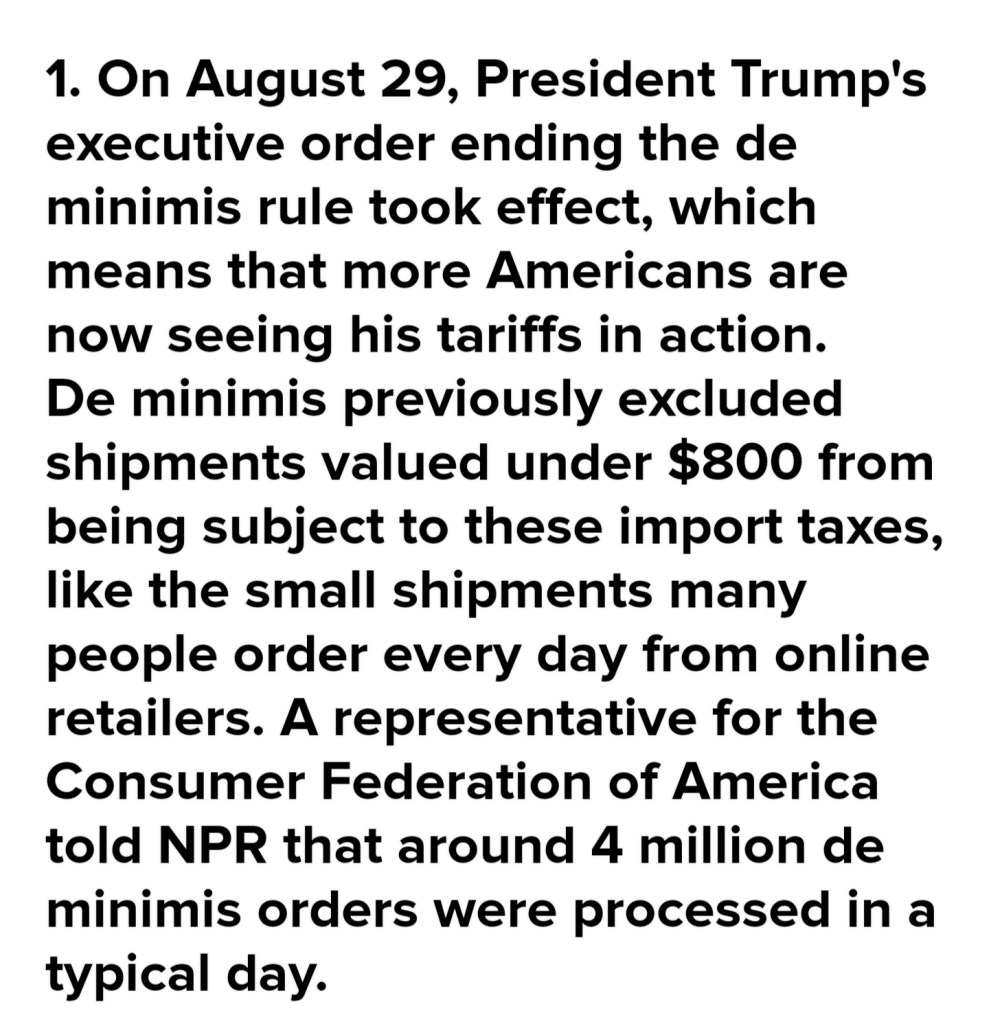

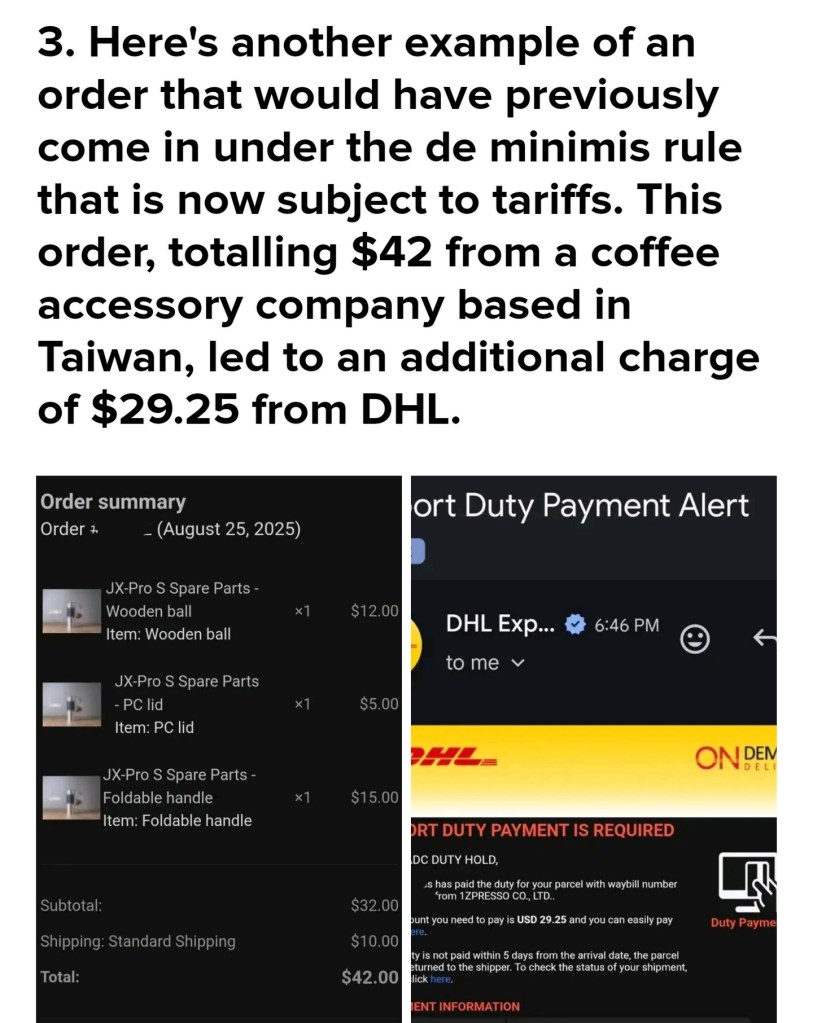
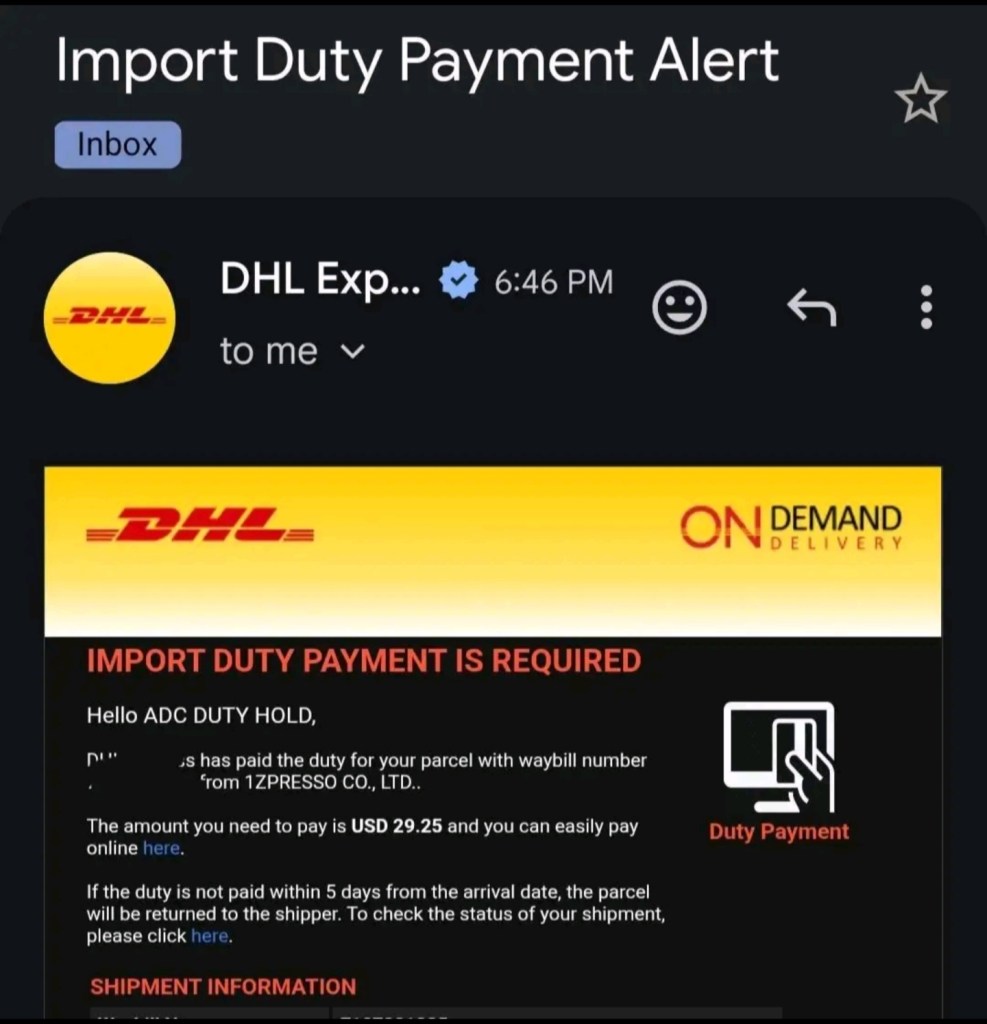
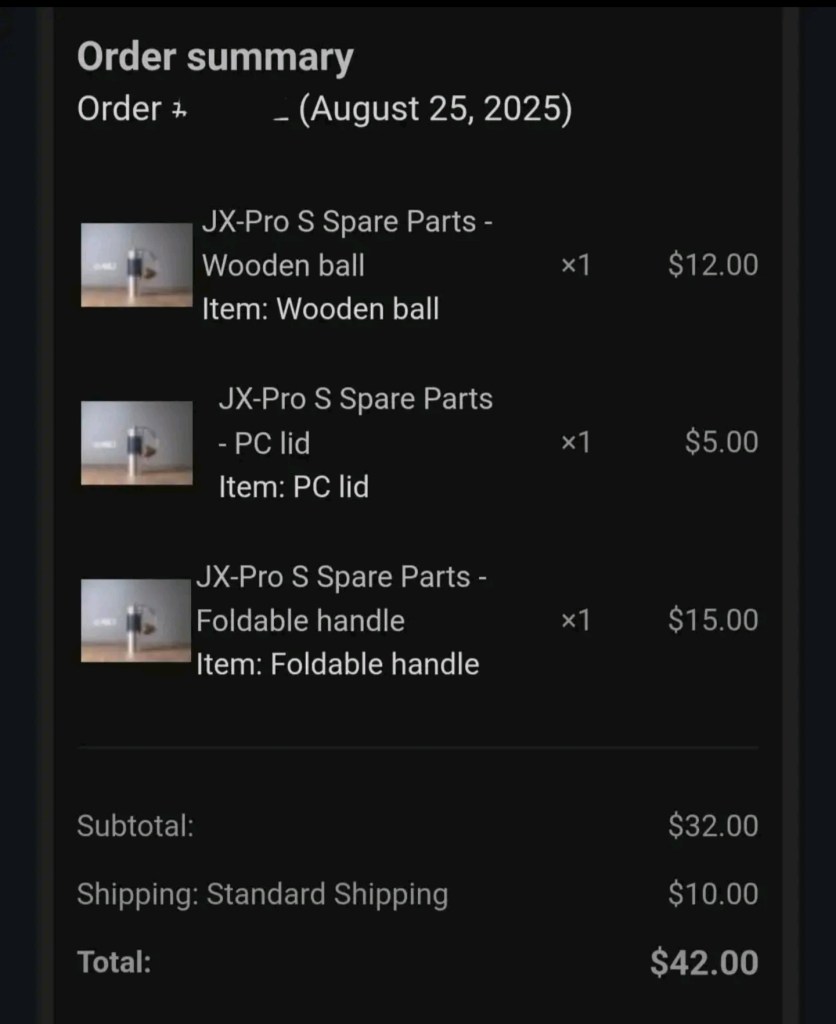
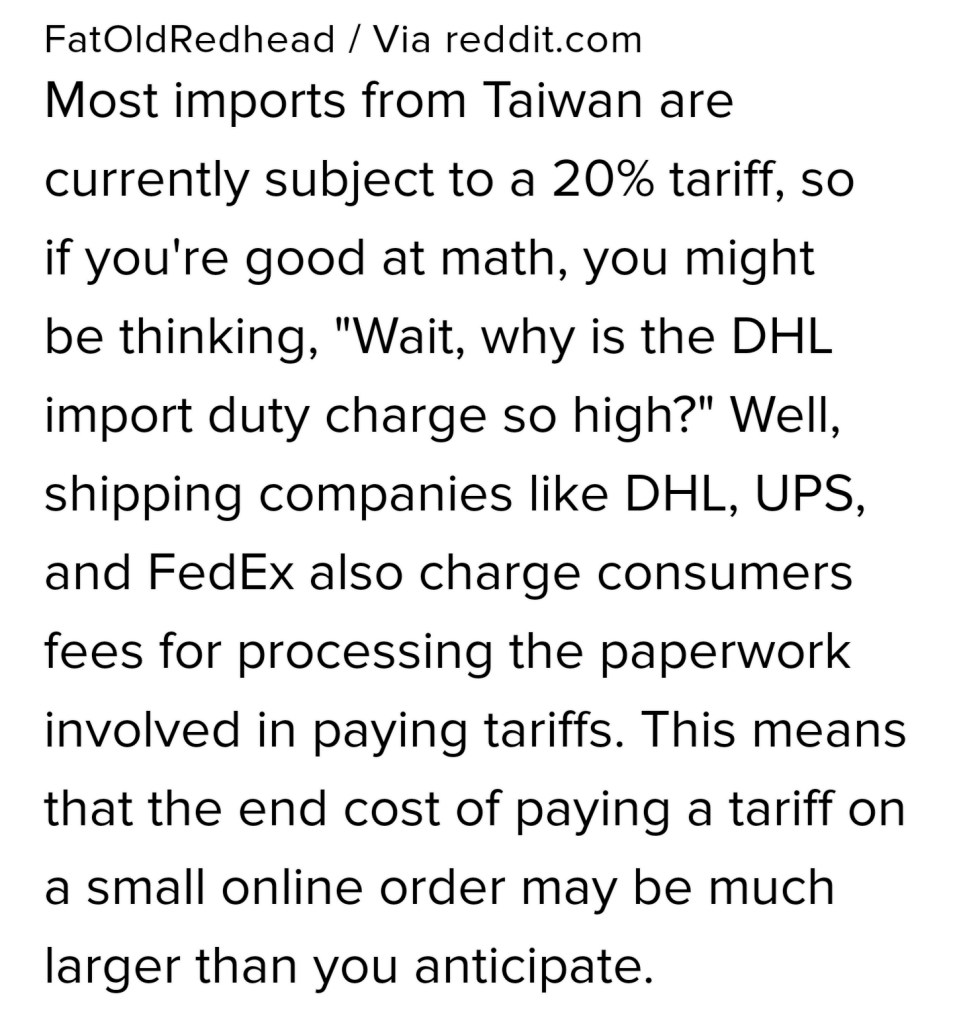



To read the original article that inspired this blog piece, click the highlighted link below.
Read ““Just Got My First Tariff Bill”: People Are Sharing How The “Trump Tax” Is Showing Up In Their Lives” on SmartNews: https://l.smartnews.com/p-6atJx14Y/85qB7A
 Leila World Blog