

Tom Homan the ICE high level official under the Obama Administration vs the ICE Border Czar, under the Trump Administration, what’s the difference?
So…
Someone posted this statement, to this picture. I think people need to really get the big picture details, before making broad stroke statements. Because “the devil is always in the details”, as they say. Details and context matter, especially in such a chaotic, unsettling, world and society, we are currently living in.
Here is the statement made:
“Isn’t that weird?? What’s the difference?? Oh that’s right! It’s the little letter next to the president’s name that causes all of this hypocrisy!! Shame on you democrats.”
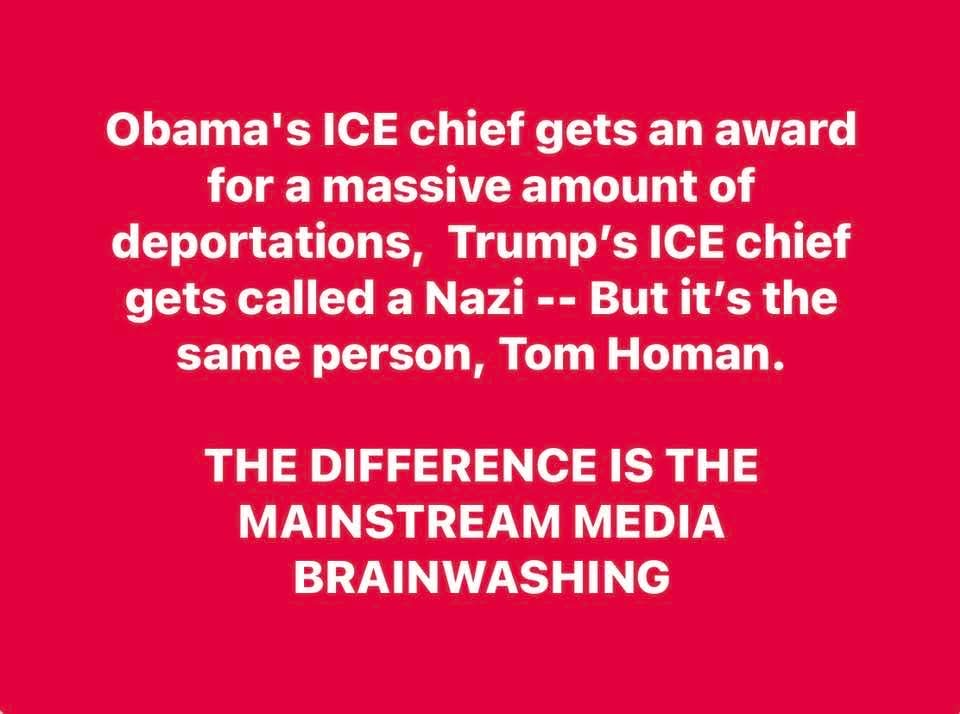
While Homan was a high-level official under President Obama, he was not the Senate-confirmed Director of ICE during that time; he led the Enforcement and Removal Branch.
To be exact:
Under the Obama Administration, Tom Homan held the following official titles within U.S. Immigration and Customs Enforcement (ICE):
**Executive Associate Director (EAD) of Enforcement and Removal Operations (ERO):
He was appointed to this role in May 2013. In this position, he served as the “first-in-command” of ERO, the division of ICE responsible for the apprehension and removal of individuals in violation of immigration laws.
Assistant Director for Enforcement:
Prior to his promotion to EAD, he accepted this position at ICE Headquarters in March 2009.
Deputy Executive Associate Director: He also served in this capacity before being elevated to the top leadership of ERO.
vs
In the current administration, Tom Homan serves as the “Border Czar.”
Specifically, he is the White House Border Czar, a position he assumed on January 20, 2025. In this role, he is responsible for overseeing the security of the nation’s borders (including the Southern and Northern borders, as well as maritime and aviation security) and lead the administration’s deportation operations.
Key Details of the Role
Official Authority:
He is in charge of all deportations of unauthorized individuals to their countries of origin.
Reporting Structure:
The position is based within the White House rather than a specific agency (like DHS or ICE), which allows him to coordinate between various federal departments.
Confirmation:
Unlike a Cabinet-level position, this “czar” role did not require Senate confirmation, allowing him to begin his duties immediately upon the President’s inauguration.
Now, because he has zero monitoring, and has unlimited free reign, and is being directed by Trump, he and ICE are out of control. Also under Obama, he was held accountable. Now he is not.
Recently several off duty Police Officers (U.S. Citizens) in Minnesota and more states have been targeted by ICE because because their skin is brown or black or tan. The situation is so bad, the Police Chiefs have had to do press conferences, as well as Mayors, and the Govenor, stating how badly they are acting towards Officers of the Law who are not visibly Caucasian. They are being asked for proof of legality in the U.S. documentation and more. Some being detained before even being able to identify themselves as Officers. As a U.S. Citizen, it is not required that we carry documentation as Proof of Citizenship, or Proof of Legality to occupy in the United States.
Another difference under the Obama Administration, his ICE Agents were thoroughly screened and properly trained. They enforced the Constitutional Law and Legal Laws of the United States. The Obama Administration did not try to bypass the law, Congress, or create Executive Orders for their illegal acts, which the current Trump Administration is doing. Where as, the current agents, have been proven to be barely screened, if at all, and barely trained, if at all. That makes them borderline, if not in fact, Government hired rogue militia.
A militia is generally defined as a military force composed of ordinary citizens rather than professional, full-time soldiers. While the term’s meaning has shifted over centuries, it fundamentally refers to a “citizen army” that can be called upon in times of emergency.
In the United States, the definition is often categorized into three distinct contexts:
1. Legal & Statutory Definition
Under federal law (10 U.S. Code § 246), the “militia of the United States” consists of all able-bodied individuals aged 17 to 45 who are citizens (or intended citizens). This is divided into two groups:
The Organized Militia:
Consists of the National Guard and the Naval Militia.
The Unorganized Militia:
Consists of all other eligible individuals who are not members of the National Guard but could theoretically be called into service.
2. Historical & Constitutional Context
At the time of the American Founding, the militia was seen as a state-based alternative to a “standing army,” which many Founders feared could lead to tyranny.
The Second Amendment:
Mentions a “well regulated Militia” as being “necessary to the security of a free State.”
Well Regulated:
In the 18th century, this phrase typically meant “disciplined,” “organized,” or “in proper working order,” rather than being burdened by government regulations.
3. Modern & Private Context
In contemporary language, the word is also used to describe:
Private Paramilitary Groups:
Armed groups of private citizens who organize themselves independently of the government. These groups often cite the Second Amendment as their justification, though many states have laws prohibiting private “paramilitary training” or the unauthorized exercise of law enforcement power.
International Variations:
In some countries (like Switzerland or Israel), “militia” refers to a system where almost all adult citizens are trained and remain on “reserve” status for national defense.
So, by pure definition alone, our current ICE is a modern day Militia. Out of control Militia. I am NOT saying abolish ICE, but they need to be accountable under a checks and balance system. They need to pursue criminal illegals. Meaning those that have committed actual crimes, first.
Reality is illegals in the U.S.A. account for, as of late 2025/early 2026, estimates generally range between 11 million and 14 million people. This includes children.
Key Demographics;
Long-Term Residents:
Despite the focus on recent arrivals, the majority of undocumented immigrants are long-term residents. Approximately 45% have lived in the U.S. for 20 years or more. That means they are contributing to our economy. This is EXTREMELY IMPORTANT IN THE BIG PICTURE OF U.S. ECONOMICS AND ECONOMY!
Estimating the exact contribution of undocumented immigrants to the U.S. Gross Domestic Product (GDP) is difficult because much of their economic activity occurs in “off-the-books” sectors or is integrated into larger business supply chains. However, economists use labor participation and spending power to provide reliable estimates.
As of early 2026, the data suggests the following:
1. Direct Contribution to GDP
Undocumented immigrants are estimated to contribute approximately $1.1 trillion to $1.7 trillion to the U.S. GDP annually.
- Workforce Impact: Undocumented workers make up about 5% of the total U.S. labor force. Because they are disproportionately employed in labor-intensive industries (like agriculture and construction), their “value-add” to the economy is higher than their share of the population might suggest.
Loss Projections:
A 2025 study by the Peterson Institute for International Economics indicated that a mass removal of the undocumented population would cause a 2.6% to 6.2% drop in real GDP by 2028.
2. Tax Contributions
Despite not having legal status, undocumented immigrants pay significant taxes through sales, property, and payroll taxes (often using Individual Taxpayer Identification Numbers, or ITINs).
Total Annual Taxes:
In 2023, undocumented households paid approximately $89.8 billion in federal, state, and local taxes.
Effective Tax Rates:
In 40 states, undocumented immigrants pay a higher effective state and local tax rate (avg. 10.1%) than the top 1% of households (avg. 7.2%).
Social Security:
Undocumented workers contribute an estimated $13 billion per year into Social Security, despite being ineligible to receive benefits.
3. Industry-Specific Reliance
The contribution to GDP is concentrated in several key sectors that would face significant contraction without this labor:
Agriculture:
Undocumented workers make up roughly 45% of the agricultural workforce.
Construction:
They represent about 14% of all construction workers nationally.
Hospitality/Service:
They account for approximately 7% to 10% of the workforce in hotels and restaurants.
So, as you can figure out the contribution to our GDP drastically increases in Mixed Status Households.
Mixed-Status Households:
About 12 to 14 million people (including U.S. citizens and legal residents) live in a household with at least one unauthorized immigrant.
Country of Origin:
While Mexico remains the largest single country of origin (about 40%), its share has declined significantly over the last 15 years, while populations from Central America and Venezuela have increased.
Meanwhile…
As of January 2026, the estimated population of the United States is approximately 343 million people.
According to the U.S. Census Bureau’s population clock, the exact count fluctuates by the second due to births, deaths, and migration, but the current daily estimate sits at roughly 343,129,000.
Recent Trends & Changes
Decelerating Growth:
While the population is still growing, the rate of increase is expected to slow over the coming decades. Projections from the Congressional Budget Office (CBO) suggest that by 2030, the number of deaths may begin to exceed the number of births, meaning future growth will rely almost entirely on net immigration.
Migration Impacts:
In 2025 and early 2026, the population saw a slight dip in growth rates compared to the “peak” years of 2023–2024. This is largely attributed to a decrease in the immigrant population due to increased deportations and voluntary departures.
Most Populous States:
California remains the largest state (approx. 39 million), followed by Texas (approx. 31 million) and Florida (approx. 23 million).
The U.S. Census Bureau estimates the “components of change” as follows:
- One birth every 9 seconds.
- One death every 10 seconds.
- One net international migrant every 28 seconds (this rate has slowed recently).
- Net Gain: Overall, the U.S. population increases by one person roughly every 22–24 seconds.
1. Crime Rates: Undocumented Immigrants vs. U.S. Citizens
Most academic and non-partisan studies indicate that undocumented immigrants are arrested and convicted at lower rates than native-born U.S. citizens.
Texas Data (The “Gold Standard”): Texas is the only state that records the immigration status of every person arrested. A multi-year study (updated through 2024–2025) found that undocumented immigrants had:
45% lower arrest rates for violent crimes than native-born citizens.
62% lower arrest rates for drug-related crimes.
75% lower arrest rates for property crimes.
National Incarceration Rates: According to the Cato Institute, the incarceration rate for undocumented immigrants is approximately 613 per 100,000, which is significantly lower than the rate for native-born citizens (roughly 1,400+ per 100,000).
2. Recent Enforcement Statistics (2025–2026)
Since January 2025, there has been a significant shift in federal focus toward deporting individuals with criminal records.
DHS/ICE Reports (January 2026):
The Department of Homeland Security reported that in the first year of the current administration, over 670,000 individuals were removed.
Composition of Arrests:
According to ICE data from late 2025, approximately 70% of current ICE arrests are of individuals who have either been convicted of or charged with a crime in the U.S.
Detention Demographics:
As of November 2025, approximately 73.6% of individuals currently in ICE detention have no criminal convictions. Of those who do have convictions, a large portion are for non-violent offenses such as traffic violations or illegal entry/re-entry.
3. Federal Sentencing Data
In the federal court system (which handles crimes like border crossing, drug trafficking, and money laundering):
- Immigration Offenses: These make up about 57% of all federal convictions as of early 2025.
- Non-U.S. Citizen Convictions: In 2024, non-U.S. citizens accounted for roughly 34% of federal sentencings. However, the vast majority (72%) of these were for the crime of “Unlawful Entry” or “Re-entry” itself, rather than violent or property crimes.
When looking at “criminal activity other than entering the U.S.,” researchers typically look at conviction or incarceration rates to compare groups. While it’s difficult to give a single percentage that covers every person, consistent data from the last several years (up through early 2026) shows that undocumented immigrants commit crimes at significantly lower rates than native-born U.S. citizens.
The most precise data comes from the Texas Department of Public Safety, as it is the only state that tracks the immigration status of every person arrested.
1. Crime Rates: Undocumented vs. Native-Born
According to multi-year studies (including those updated in 2025), undocumented immigrants are arrested and convicted for non-immigration crimes at a fraction of the rate of U.S. citizens.
Crime Type Undocumented Immigrant Rate vs U.S. Citizen Rate
Violent Crimes ~96 per 100,000 vs ~213 per 100,000
Property Crimes ~39 per 100,000 vs ~165 per 100,000
Drug Crimes ~135 per 100,000 vs ~337 per 100,000
Homicide ~1.9 per 100,000 vs ~4.8 per 100,000
Source: National Institute of Justice (NIJ) / Texas DPS Data Analysis.
2. Incarceration Comparison
If you look at the total population of people currently in prison or jail (the “incarceration rate”), the gap is even wider:
Native-born Americans:
Approximately 1,400+ per 100,000 are incarcerated.
Undocumented immigrants:
Approximately 613 per 100,000 are incarcerated.
Legal immigrants:
Approximately 319 per 100,000 are incarcerated.
3. Recent 2025/2026 Trends
Since the start of 2025, there has been an increased focus on the removal of “criminal aliens.”
ICE Arrests:
As of late 2025, about 70% of current ICE arrests involve individuals who have a criminal conviction or a pending criminal charge (excluding illegal entry).
Overall Impact:
Federal reports from July 2025 noted that as deportations of those with criminal records increased, violent crime in major U.S. cities saw a correlated 10% to 17% drop in categories like homicide and aggravated assault.
Why is the rate lower for undocumented immigrants?
Criminologists generally point to two main reasons:
Self-Selection:
People who migrate for work or family tend to be more “opportunity-motivated” and risk-averse.
Deterrence:
Undocumented individuals face the “double penalty” of jail time plus mandatory deportation, which acts as a significant deterrent against committing even minor crimes.
Summary Percentages
A native-born U.S. citizen is statistically over 200% more likely to be incarcerated for a crime than an undocumented immigrant, and over 400% more likely to be arrested for a property crime.
 Leila World Blog