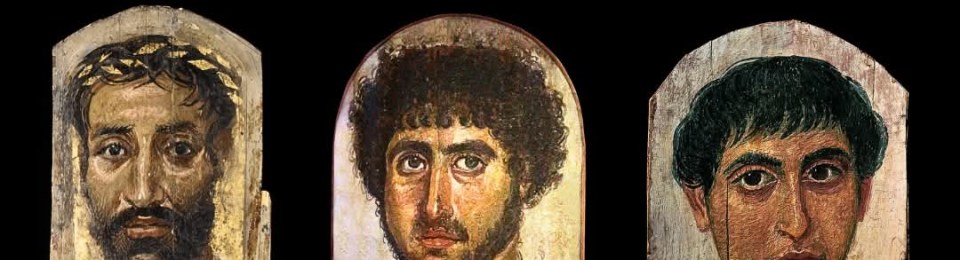
Roman society was structured around citizenship, class, and cultural identity, not skin colour. What mattered was whether someone was free or enslaved, urban or rural, Roman or foreign, wealthy or poor. People from North Africa, the Middle East, Europe, and beyond lived and worked side by side in the empire’s major cities. Soldiers, merchants, actors, priests, and even senators could come from a wide range of ethnic backgrounds. Ancient writers described people’s appearance, but they didn’t attach moral value or social rank to skin tone the way later European societies did.
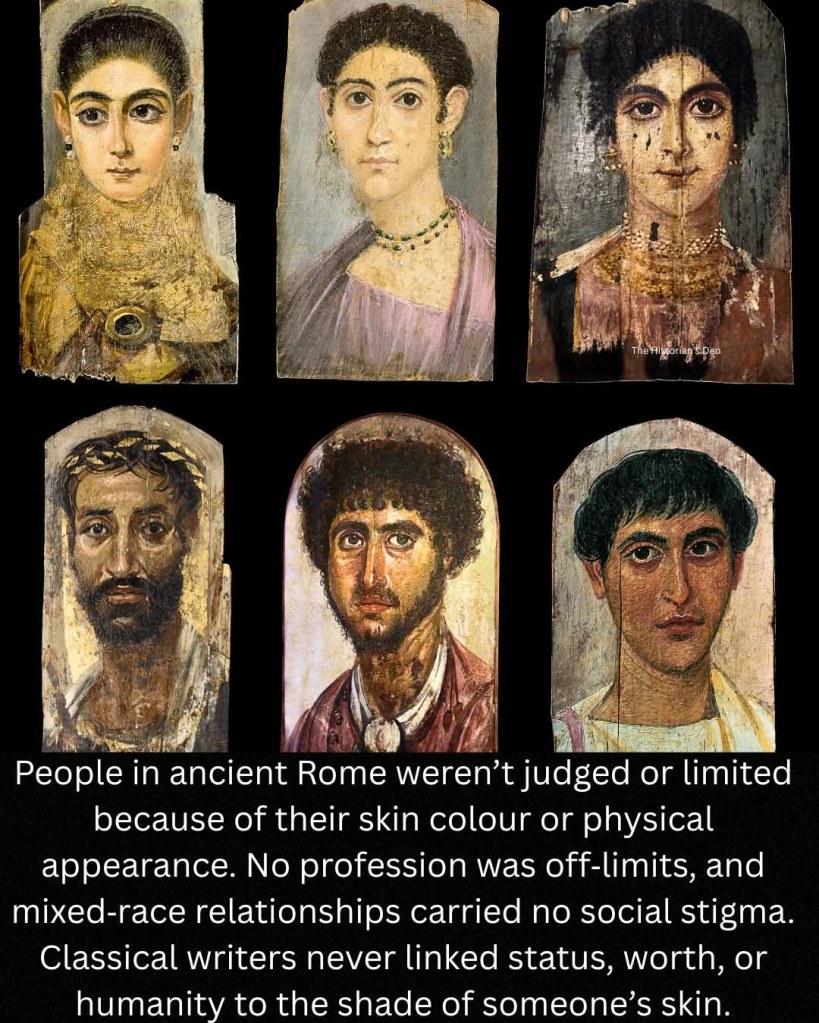
This doesn’t mean Rome was free of prejudice, far from it. Romans could be xenophobic, mocking foreigners for their customs, accents, or perceived “barbarism.” But these biases were cultural, not racial in the modern sense.
A person from anywhere in the empire could rise socially, marry whom they wished, and even become emperor if circumstances aligned.
Septimius Severus, for example, was a North African who ruled the empire. In Rome’s worldview, identity was something you could adopt through language, loyalty, and citizenship, not something fixed by physical traits.
Very interesting. So that leads to the question how did we get to where we are now?
Racism a structured ideology is a relatively modern invention—about 500 to 600 years old.
Historians generally distinguish between “prejudice” (which is ancient) and “racism” (which is a specific system of power).
1. The “Ancient” Era (Pre-1400s)
In the ancient world (Greeks, Romans, Egyptians), people definitely looked down on each other, but it was usually based on culture, language, or religion, not skin color.
The Greeks called anyone who didn’t speak Greek “barbarians,” but they didn’t believe those people were biologically inferior.
You could be a Roman citizen regardless of your physical features; what mattered was your loyalty to the Empire and your legal status.
2. The Turning Point (Late 1400s – 1600s)
The modern concept of “race” began to crystallize during the Age of Discovery and the start of the Transatlantic Slave Trade.
Justification:
As Europeans began colonizing the Americas and enslaving Africans, they needed a way to reconcile these brutal actions with their religious and “Enlightenment” values (like “all men are created equal”).
The Solution:
They “invented” the idea that humans are divided into distinct biological “races” and that some were naturally superior to others. This turned a temporary status (like being a prisoner or servant) into a permanent, hereditary identity.
3. “Scientific” Racism (1700s – 1800s)
This is when racism became “official.” Thinkers in the 18th century began creating elaborate charts and hierarchies.
In 1775, Johann Blumenbach famously divided humans into five groups (Caucasian, Mongolian, etc.).
This “pseudoscience” was used to justify everything from Jim Crow laws in the U.S. to the colonization of Africa, claiming that “nature” intended for certain groups to lead and others to serve.
The Bottom Line:
Racism isn’t a “natural” human instinct that has always existed; it was a tool designed at a specific point in history to justify economic and political power.
Modern genetics has been the “final nail in the coffin” for the idea of biological race. While we can see physical differences like skin tone or hair texture, science shows that these are literally “skin deep.”
Here is how the scientific community dismantled the myth of race:
1. The 99.9% Reality
The most famous finding from the Human Genome Project is that all humans are 99.9% genetically identical. The tiny 0.1\% difference that remains is where all our physical variation comes from.
Crucially, that variation doesn’t map onto “race” categories. There is actually more genetic diversity within a single African population than there is between an average European person and an average East Asian person.
2. The “Isolation” Myth
For “races” to be biologically real, groups of humans would have had to be separated for millions of years without ever breeding with one another (like different species of birds).
The Reality:
Humans have been migrating and “mixing” since we left Africa.
Continuous Variation:
There are no hard borders where one “race” ends and another begins. Physical traits (like skin color) change gradually across geography—a phenomenon known as a cline.
3. Traits are Not Linked
In the 1800s, “scientific” racists believed that if you had a certain skin color, you also had a certain type of brain, temperament, or athletic ability. This is called Non-concordance.
Science has proven that the genes for skin color (melanin) have absolutely nothing to do with the genes for intelligence, musical talent, or personality. They are inherited independently.
4. The “Out of Africa” Evidence
Genetic markers prove that all modern humans share a common ancestor from Africa roughly 200,000 years ago.
As groups migrated to different climates, their bodies adapted.
Example:
People in high-UV areas evolved darker skin to protect against folate depletion, while those in low-UV areas evolved lighter skin to better absorb Vitamin D.
Why do we still “see” race?
Sociologists call race a social construct. This doesn’t mean it isn’t “real”—it’s very real in terms of how people are treated, how laws are made, and how history has unfolded. It just means the categories were created by society, not by nature.
”The DNA of a person from Iceland and a person from Kenya are more similar than the DNA of two different fruit flies.”
So why the fear of those tan, brown or black? We are one race. The human race. As such, we should treat each other humanely at the very least. Those who act inhumane should be punished in accordance to the law, and Constitution of the Land.
Yet here we are becoming seemingly more savage as time evolves.
 Leila World Blog